

Quick answer: tank or tankless?
Lowest upfront cost
A 40 to 50 gallon gas tank, typically $1,800 to $3,200 installed in Ottawa.
Lowest operating cost and longest life
A condensing gas tankless heater, typically $3,500 to $6,500 installed, often lasting 15 to 20 years.
Endless hot water
Tankless, as long as it is sized for Ottawa’s cold winter inlet water.
Simplest swap
A tank, especially if your current one is the same size and venting type.
Space
Tankless mounts on a wall and frees up about a square metre of basement floor.
Power outages
Both a tankless unit and a power-vented tank need electricity; only an older chimney-vented tank keeps heating without power.
Final prices depend on your home, the equipment you choose, and the venting and gas piping needed. Oria gives free estimates on new installations.

How a tank and a tankless water heater actually work
A tank water heater keeps 40 to 60 gallons of water hot around the clock. A gas burner under the tank fires whenever the water cools, including overnight when nobody is using it. That reheating is called standby loss.
A tankless (on-demand) water heater has no storage. When you open a hot tap, water flows through a compact heat exchanger and a burner of up to roughly 199,000 BTU/h heats it on the spot. When you close the tap, the burner shuts off.
Most gas tankless units Oria installs are condensing models. They pull extra heat out of the exhaust, vent through plastic pipe out a side wall, and drain a small amount of acidic condensate, much like a high-efficiency furnace.
Tank vs tankless water heater: side-by-side comparison
| Factor | Gas tank (40 to 50 gal) | Gas tankless (condensing) |
|---|---|---|
| Typical installed cost in Ottawa | $1,800 to $3,200 | $3,500 to $6,500 |
| Operating cost | Higher: heats stored water 24/7 (standby loss) | Lower: heats only when a tap is open |
| Typical efficiency (UEF) | About 0.60 to 0.70 for standard tanks; higher for condensing tanks | About 0.90 to 0.97 for condensing models |
| Typical lifespan | 8 to 12 years | 15 to 20 years with regular descaling |
| Space needed | Floor space about 55 to 65 cm across, 1.3 to 1.6 m tall | Wall-mounted, about the size of a carry-on suitcase |
| Hot water capacity | Limited by tank size; a 50 gal gas tank delivers roughly 70 to 90 gallons in the first hour | Continuous, limited by flow rate (gallons per minute) |
| Maintenance | Flush yearly; check anode rod every few years | Descale and clean inlet screen yearly (more often on hard well water) |
| Venting | Chimney (natural draft) or power vent | Sidewall PVC or polypropylene venting |
| Gas supply | Usually works on existing piping | Often needs a larger gas line for the high burner input |
| Rental option | Common, roughly $25 to $45/month in Ontario | Available, usually at the higher end of rental pricing |
Ranges are typical Ottawa installed prices in CAD before any rebates, not quotes.
Upfront cost: why tankless costs more to install
The tankless unit itself costs more, but the bigger difference is often the installation. A condensing tankless heater usually needs new venting through a side wall, a condensate drain and, in many Ottawa homes, an upgraded gas line.
That gas line matters. A 199,000 BTU/h tankless heater can draw more gas than your furnace, and a basement line sized years ago for a 40,000 BTU/h tank may be too small. A licensed gas technician should check pipe size and length before you commit.
A like-for-like tank replacement is the cheapest job: the new tank connects to the same water lines, gas line and vent. If your old tank vents into a chimney you no longer share with a furnace, the chimney may need a liner or the new tank may need a power vent, which raises the cost.
Operating cost: where tankless earns its money back
A standard gas tank wastes heat keeping water hot while you sleep and work. A condensing tankless heater skips that standby loss and burns gas more efficiently when it does run, so its gas use for water heating is usually noticeably lower.
The savings depend on how much hot water you use. A busy family of five running laundry, dishes and several showers a day sees the biggest benefit. A single person in a condo-sized space sees less, because standby loss is a larger share of a small bill but the total bill is small.
On the Enbridge Gas bill, water heating is usually the second-biggest gas use after the furnace. If you rent your tank, your monthly rental fee also appears on a bill, which makes it easy to compare against owning. Our rent vs buy water heater guide runs those numbers in detail.
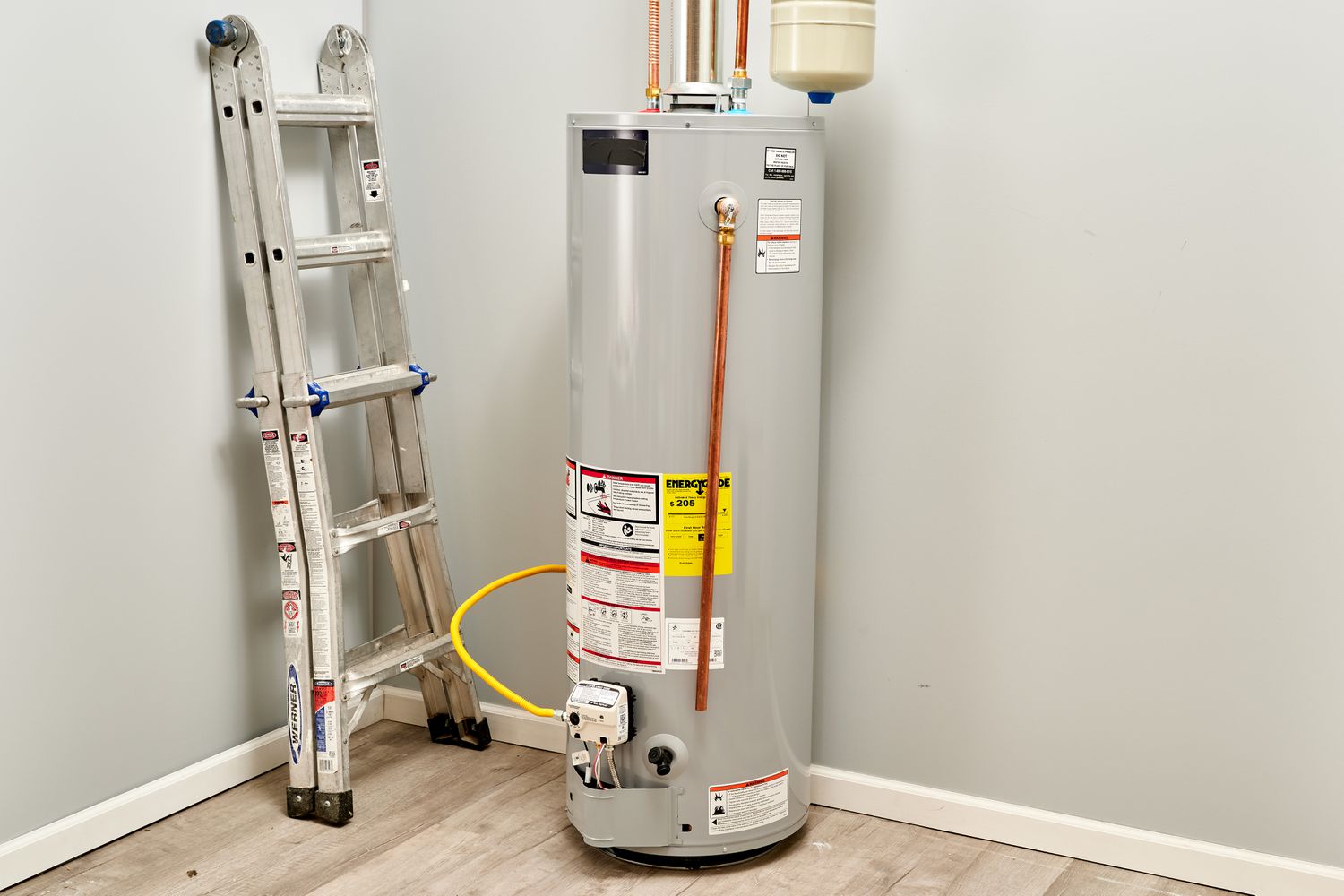
Hot water capacity in an Ottawa winter
This is where the Ottawa climate changes the answer. In January, water entering your home from city mains or a well can be only a few degrees above freezing. A tankless heater has to raise that water by roughly 45 to 50 °C to reach shower temperature.
A properly sized gas tankless unit (around 199,000 BTU/h) typically delivers about 4 to 5 US gallons per minute in winter. That covers two showers and a kitchen tap at the same time. Undersized or electric tankless units can struggle, which is why some Ottawa homeowners complain of lukewarm winter showers.
A tank stores a fixed amount. A 50 gallon gas tank handles back-to-back showers well, but filling a deep soaker tub and then running two showers can empty it, and recovery takes time. A 60 gallon tank or a tankless unit suits larger families better.
Quick sizing rule of thumb
- 1 to 2 people, one bathroom: 40 gallon tank or a mid-size tankless unit.
- 3 to 4 people, two bathrooms: 50 gallon tank or a 180,000 to 199,000 BTU/h tankless unit.
- 5 or more people, soaker tub or three bathrooms: 60 gallon tank, a large tankless unit, or two tankless units in series.
A technician should confirm sizing by counting fixtures and checking your actual inlet water temperature.
Lifespan and maintenance
Most gas tanks last 8 to 12 years. The tank eventually corrodes from the inside and leaks, often without much warning. A tank in a finished basement should have a drain pan or a leak sensor.
Tankless heaters commonly last 15 to 20 years because there is no tank to rust through. The trade-off is maintenance: minerals in the water build up inside the heat exchanger and must be flushed out with a descaling solution, usually once a year.
City of Ottawa water drawn from the Ottawa River is on the softer side, so descaling every 12 months is usually enough. Rural homes on hard well water in areas like Greely, Richmond or Carp may need a water softener or descaling more often to protect a tankless unit.
Simple yearly maintenance
- Tank: drain a few litres from the bottom valve to clear sediment, test the relief valve, and have the anode rod checked every 3 to 5 years.
- Tankless: descale the heat exchanger, clean the cold-water inlet screen, check the vent termination is clear of snow, and inspect the condensate drain.
Who should pick which in Ottawa
A tank is usually the better choice if you:
- Need to replace a failed tank quickly with the lowest upfront cost.
- Expect to move within five years, so a longer-lasting unit will not pay back for you.
- Have a small household with modest hot water use.
- Want hot water during power outages and have a working chimney-vented setup.
- Prefer renting so repairs and replacement are covered for a monthly fee.
Tankless is usually the better choice if you:
- Have a larger family or frequently run out of hot water.
- Plan to stay 10 years or more, long enough for lower gas use and longer life to offset the higher price.
- Are finishing the basement and want the floor space back.
- Already have, or can easily run, a properly sized gas line and a sidewall vent.
- Upgraded to a high-efficiency furnace and are left with an old chimney serving only the water heater.
For homes with hot water radiators, a high-efficiency combi boiler that provides both space heating and on-demand hot water can be another option. See our boiler services page for details.
Rebates, financing and next steps
Rebates may be available for high-efficiency water heaters, but programs change. Oria will check current programs for your home, and you can read more on our HVAC rebates page. Financing is available on approved credit, with plans from $49/month.
Oria Heating and Cooling has served Ottawa since 2005 with TSSA-approved, gas-licensed technicians and 24/7 emergency service for water heaters. If your tank is leaking or you want to compare options, see our hot water tank installation and tankless water heater installation pages, or call (613) 866-1869 for a free estimate.
Frequently Asked Questions
Is a tankless water heater worth it in Ottawa?
A gas tankless water heater is usually worth it in Ottawa for households of three or more that plan to stay at least 10 years. It costs $3,500 to $6,500 installed versus $1,800 to $3,200 for a tank, but it uses less gas, lasts 15 to 20 years and never runs out. Smaller households moving soon often do better with a tank.
Will a tankless water heater keep up in an Ottawa winter?
Yes, if it is sized correctly. Winter inlet water in Ottawa can be just above freezing, so the heater must raise it by about 45 to 50 °C. A gas unit of around 199,000 BTU/h typically supplies 4 to 5 gallons per minute in winter, enough for two showers and a tap at once. Small electric tankless units often cannot keep up.
How long does a tank water heater last compared with tankless?
A gas tank water heater typically lasts 8 to 12 years before the tank corrodes and leaks. A gas tankless water heater commonly lasts 15 to 20 years because it has no storage tank to rust, provided the heat exchanger is descaled about once a year. Hard well water shortens the life of both types unless it is treated.
Do tankless water heaters work during a power outage?
No. Gas tankless water heaters need electricity for their controls, igniter and exhaust fan, so they stop heating during a power outage. Power-vented gas tanks also stop. An older natural-draft tank vented into a chimney keeps heating without power, though you still have the hot water already stored in any tank.
Do I need a bigger gas line for a tankless water heater?
Often, yes. A whole-home gas tankless heater can be rated around 199,000 BTU/h, several times the input of a typical 40,000 BTU/h tank. Many existing Ottawa gas lines were sized only for the old tank and furnace. A licensed gas technician measures pipe size, length and total load to see whether the line must be upgraded.
Can I rent a tankless water heater instead of buying one?
Yes, tankless water heaters can be rented in Ontario, but rental fees for tankless units tend to sit at the higher end of the roughly $25 to $45 per month range for water heater rentals. Before signing, compare the total rent over 10 to 15 years with the $3,500 to $6,500 cost of buying, and read the buyout terms.
How much space does a tankless water heater save?
A typical 50 gallon tank takes up a floor footprint about 55 to 65 cm across, plus clearance around it. A tankless unit mounts on the wall and is roughly the size of a carry-on suitcase, so it frees up close to a square metre of floor. That is helpful when finishing a basement or creating storage in a utility room.
Related Reading
Need help with your heating or cooling?
Family-owned, licensed HVAC contractor serving Ottawa and Gatineau since 2005. 5.0 stars from 396 Google reviews.