
Quick answer: the 12 checks
Work through these in order. The first six take a few minutes and solve a surprising number of no-heat calls in Ottawa.
- Thermostat set to Heat, set above room temperature, with fresh batteries
- Furnace filter not clogged
- Breaker on and furnace service switch on
- Furnace door closed tight (door safety switch)
- Gas valve open and other gas appliances working
- Intake and exhaust pipes outside clear of snow, frost and ice
- Supply and return vents open and unblocked
- Condensate drain, trap and pump flowing (not frozen or full)
- Error code on the control board read and noted
- Pressure switch fault ruled in or out
- Flame lights, then shuts off (flame sensor)
- One clean power reset, not repeated resets
Stop immediately if you smell gas, a carbon monoxide alarm sounds, or you see scorching or smell burning wiring. Get everyone outside and call for help from there.
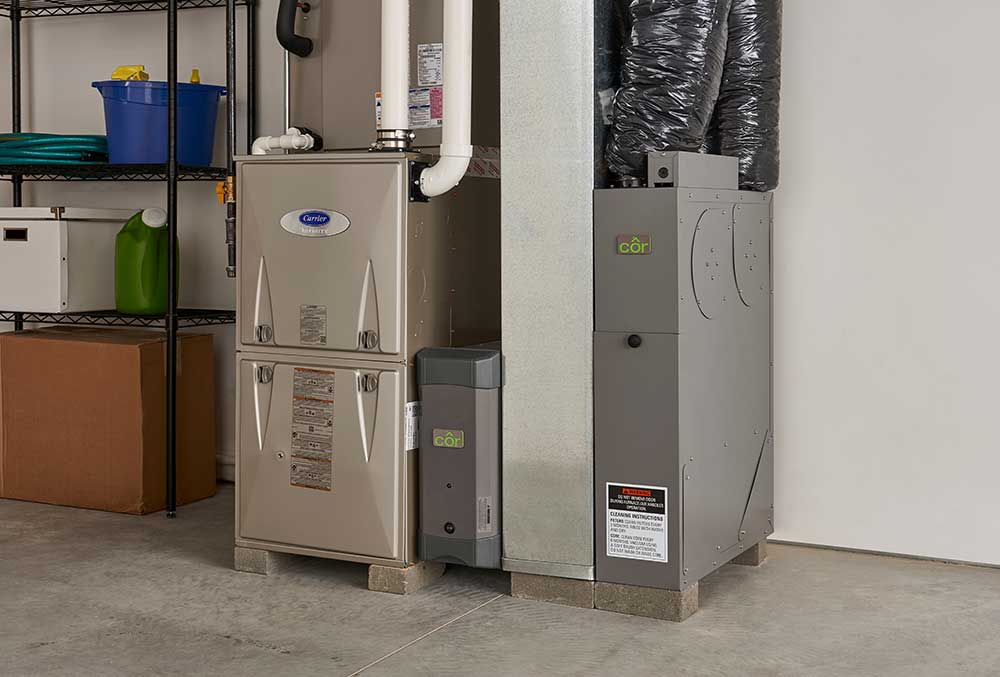
Checks 1–4: thermostat, filter, power and the furnace door
1. Thermostat
Make sure it is on Heat (not Cool, Off or Emergency Heat on a heat pump) and set at least 2 °C above the room temperature. Replace the batteries if the screen is blank or dim. Smart thermostats can also be stuck on a schedule, an away mode or a Wi-Fi outage, so try a manual temporary hold.
2. Furnace filter
A badly clogged filter starves the furnace of air. The heat exchanger overheats, the high-limit switch trips and the burners shut off, often after only a few minutes of heat. Slide the filter out and hold it to a light. If you cannot see through it, replace it. Our guide to furnace filters and MERV ratings covers sizes and how often to change them.
3. Breaker and service switch
Check the panel for a tripped furnace breaker and reset it once. Then find the furnace service switch, which looks like a light switch on the furnace, a nearby wall or at the top of the basement stairs. It gets flipped off by accident more often than you would think.
4. Furnace door switch
Every modern furnace has a safety switch behind the lower blower door. If the panel is loose or not seated after a filter change, the furnace will not run at all. Press the door firmly into place and listen for the furnace to start its sequence.
Checks 5–8: gas, vents, airflow and the condensate line
5. Gas valve
The manual gas shutoff on the pipe beside the furnace should have its handle parallel to the pipe. Check that your stove or water heater has gas too. If nothing gas-fired works, the issue may be the meter or supply, so contact Enbridge Gas. Never relight or adjust gas controls if you smell gas.
6. Intake and exhaust pipes after a snowstorm
High-efficiency furnaces breathe through two white PVC pipes on an outside wall. In an Ottawa storm, drifting snow, frost or an ice cap can block them, the pressure switch trips and the furnace shuts down. During heavy snowfall, check and clear the pipes every couple of hours and keep about 30 cm clear around them. Brush snow away by hand; do not chip ice off the pipe with a shovel.
7. Supply and return vents
Closed registers, furniture over a return grille or a crushed duct can cause weak airflow, cold rooms and overheating. Open the vents in the rooms that feel cold and make sure the big return grilles are clear. If some rooms stay cold while others are fine, the cause may be ductwork or balancing rather than the furnace.
8. Condensate drain, trap and pump
A high-efficiency furnace makes water. If the drain line freezes in a cold garage or crawlspace, the trap clogs, or the condensate pump fills up, a safety switch stops the burners. Look for water pooling around the furnace, a full pump reservoir or a line running through an unheated space.
Checks 9–12: error codes, pressure switch, flame sensor and reset
9. Error codes
Most furnaces have a small window in the lower door with a blinking LED. Count the flashes and match them to the chart on the inside of the door. Take a photo of the code before resetting anything, because it helps a technician diagnose the problem faster.
10. Pressure switch
The pressure switch confirms the draft inducer motor is pulling combustion gases out of the heat exchanger and up the vent. If it does not see the right pressure difference, the furnace will not light. Common causes are a blocked vent, a cracked or water-filled hose, a clogged condensate trap or a weak inducer. Never bypass a pressure switch; it is there to keep exhaust out of your home.
11. Flame sensor
If the burners light and then shut off after 3 to 10 seconds, the flame sensor is often coated and cannot confirm the flame. A technician can clean or replace it quickly. If you are not comfortable working inside the burner compartment with the power off, leave it to a pro.
12. One power reset
Turn the service switch off for 30 seconds, then back on. Many furnaces lock out for about an hour after several failed ignition attempts, and a reset clears that. If it fails again, stop. Repeated resets can flood the heat exchanger with unburned gas or hide a real fault.
Common furnace symptoms and what they usually mean
| What you notice | Likely cause | DIY or call? |
|---|---|---|
| Nothing happens at all | Thermostat, breaker, service switch, door switch | DIY checks first |
| Inducer runs, burners never light | Pressure switch, blocked vent, condensate trap, igniter | Clear vents; then call |
| Burners light, then shut off in seconds | Dirty flame sensor | Call (quick repair) |
| Heats for a few minutes, then stops | Clogged filter, high-limit trip, blocked returns | Change filter; call if it repeats |
| Blower runs, air is cold | Ignition failure, gas supply, lockout | Check gas valve; then call |
| Water around the furnace | Condensate line, trap or pump | Call |
| Loud bang, screech or grinding | Delayed ignition, blower or inducer motor | Turn off and call |
Most furnace repairs in Ottawa cost $150 – $900. Major parts such as a blower motor, control board or inducer typically run $600 – $2,000. The final price depends on the home and the equipment. Strange sounds have their own guide: furnace noises and what they mean.
When to call for emergency furnace service
Call right away, day or night, if any of these apply:
- You smell gas (rotten eggs). Leave the house without touching switches, then call Enbridge Gas or 911 from outside.
- A carbon monoxide alarm is sounding. Get everyone outside and call 911. Learn the warning signs in our furnace carbon monoxide safety guide.
- You smell burning plastic or wiring, or see scorch marks.
- The furnace has failed again after one reset and the house is cooling quickly.
- Indoor temperature is falling toward 15 °C during a deep freeze, or there are babies, seniors or anyone medically vulnerable at home.
Oria offers 24/7 emergency HVAC service across Ottawa, and same-day repair is often available. As Phil G. wrote in his review: “Mansoor was incredibly fast to respond, offered help over the phone and came over the following morning.”
Protect your pipes while you wait
At −25 °C, a house without heat cools quickly, and water pipes on outside walls are the first to freeze. While you wait for a technician:
- Open cabinet doors under sinks on exterior walls so room air reaches the pipes.
- Let a cold tap drip on the farthest fixture from the water main.
- Keep interior doors open and close blinds and curtains to hold heat in.
- Use space heaters safely: plugged directly into the wall, at least 1 metre from anything that can burn, never left on unattended.
- Never heat the house with a gas oven, BBQ or generator indoors. They produce carbon monoxide.
- Know where your main water shutoff is in case a pipe does burst.
If you are away for the winter, have someone check the house every day or two. Most no-heat calls are avoidable with a yearly tune-up; see our furnace maintenance checklist or book furnace repair in Ottawa if the checks above did not get the heat back on. Call (613) 866-1869 any time.
Frequently Asked Questions
Why is my furnace running but not blowing hot air?
If the blower runs but the air is cold, the burners are not lighting or are shutting off early. Common causes are a closed gas valve, a blocked intake or exhaust pipe, a tripped pressure switch, a dirty flame sensor or a failed igniter. Check the gas valve and outside pipes, read the error code, then call a licensed technician.
How do I reset my furnace?
Turn off the furnace service switch or breaker for about 30 seconds, then turn it back on. The furnace will restart its ignition sequence. Do this only once. Many furnaces lock out after several failed ignition attempts, and repeated resets can hide a real fault. If the furnace fails again, note the error code and call for service.
Can snow stop my furnace from working?
Yes. High-efficiency furnaces draw air in and vent exhaust through PVC pipes on an outside wall. Drifting snow, frost or ice can block them, and the pressure switch shuts the furnace down for safety. During heavy Ottawa snowfalls, check the pipes every couple of hours and keep about 30 cm of clear space around them.
What does a furnace pressure switch do?
A pressure switch confirms that the draft inducer motor is moving combustion gases out of the heat exchanger and up the vent. If it does not sense the correct pressure difference, it stops the furnace from lighting. Blocked vents, clogged condensate traps, cracked hoses and weak inducer motors are the usual causes of pressure switch faults.
How long can a house go without heat in an Ottawa winter?
It depends on insulation and outdoor temperature, but at −20 °C to −30 °C a home can lose several degrees within a few hours. Pipes on outside walls are at risk once indoor temperatures fall well below normal. Do not wait overnight hoping it improves; call for emergency service and take steps to protect your pipes.
How much does an emergency furnace repair cost in Ottawa?
Most furnace repairs in Ottawa cost $150 – $900, while major parts such as a blower motor, control board or inducer typically run $600 – $2,000. The final price depends on the home, the equipment and the part involved. A good technician will tell you the cost before starting work and whether a repair makes sense on an older furnace.
Is it safe to run my furnace if it keeps shutting off?
A furnace that keeps shutting off is protecting itself, usually because of overheating, poor airflow or a venting problem. Replace the filter and clear the outside pipes first. If it continues, stop resetting it and call a technician. Running a furnace with a venting or heat exchanger problem can be a carbon monoxide risk.
Related Reading
Need help with your heating or cooling?
Family-owned, licensed HVAC contractor serving Ottawa and Gatineau since 2014. 5.0 stars from 578 Google reviews.